Free Delivery On Orders Above $140

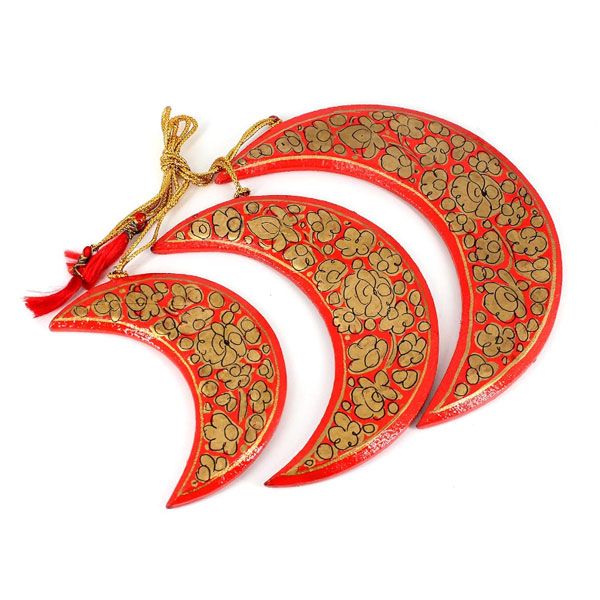


Paper Mache Set of 3 Moons
As low as
$17.00
S-Mart | Christmas Tree Decor | Kashmiri Hand-Crafted Paper Mache | Christmas Hanging | Moon Set of 3 | Christmas Ornaments | Christmas Décor | Paper Mache Work
Availability:
In stock
SKU
Paper Mache Set of 3 Moons
THE ART OF KASHMIRI PAPER MACHE...THE STORY BEHIND THE CRAFT
‘Paper mache’ is a French term which when translated literally means ‘chewed paper’. This art is said to have originated in China hundreds of years ago.
In this article, we share with you everything that you need to know about the Kashmiri Paper Mache crafts.
- Handmade paper mache Christmas ornaments, handcrafted by the artisans from Kashmir valley.
- It is very light in weight and can be hanged anywhere on tree, door, lamp, knobs, etc
- Decorative item for Christmas and other festive celebrations
- Made from recycled paper, handprinted with natural colours. Set of 3 hanging Santa is a perfect eco-friendly Christmas decor.
- Every step of the manufacturing process is done entirely by hand by expert artists of Kashmir, India
When we think of Kashmiri arts and crafts, the first few things that come to mind are shawls, carpets, rugs, and probably woodwork and embroidery. However, something that the world does not know is that Kashmir is also very well-known for its paper mache crafts. Today, the paper mache handicraft is as ingrained in Kashmir’s culture as any other handicraft.
We know paper mache as the craft that we made for school projects or during vacations as kids. But, the Kashmiri paper mache craft is a true art that has been passed down from generation to generation for centuries.
It is hard to imagine that something made out of waste paper could look so beautiful and elegant. The Kashmiri craftsmen are so amazingly skilled that they can turn even discarded paper into an attractive work of art.
The History of Kashmiri Paper Mache Crafts
The origin of the paper mache crafts in Kashmir dates back to as early as the 15th century. And the credit for bringing this art form to Kashmir is believed to go to the eighth ruler of Kashmir, Zain-ul-Abidin. He came across this art during his time as a Kashmiri prince in Samarkand, Central Asia. That was when he was intrigued by paper mache handicraft.
When he returned to Kashmir, he brought many craftsmen along with him to the valley to train his subjects on the same.
Yet another legend suggests that this art was introduced in Kashmir by a poet and Sufi saint called Mir Sayyid Ali Hamdani. He came to Kashmir from Iran in the mid 14th century. He brought along with him 700 artisans from Iran. These artisans are thought to have taught the local Kashmiris various art forms; and paper mache craft was one of them.
No matter what the story of its origin, this art was made highly popular during the Mughal rule.
The art was originally known by its Iranian name Kar-i-Qalamdani in Kashmir. The word ‘Qalamdani’ is basically pen case. Initially, this art was only restricted to making pen cases.
But, through the years, the art of paper mache has tremendously grown in the valley with numerous items available these days.
How are Kashmir Paper Mache Crafts Made?
The artisans involved in this profession are supremely skilled and practice the art for years and years. This art has also traditionally existed as a family profession in Kashmir. And like many other Kashmiri handicrafts, the trick and technique behind it gets passed on from one generation to another.
Even though the idea behind this handicraft might sound relatively simple, it is a very time-consuming process and requires a lot of precision. It basically involves two main steps- Sakthsazi (making of the actual item) and Naqashi (the painting and decoration part).
Now, let’s take a look at the making of paper mache handicrafts in detail.
Sakthsazi
The sakthsazi is the one involved with making the object with the pulp of paper. First of all, the waste paper is soaked in water for several days. Then, a mixture of the soaked waste paper, cloth and the straw of a rice plant is pounded manually in a stone mortar. This is pounded until the mixture becomes very fine and forms a pulp. Then, a rice based glue called ‘Atij’ is combined with this pulp mixture.
This complete mixture is then applied onto the desired mould and then left to dry for a few days. After it has dried out, the artwork is very carefully separated from the mould. The artwork is basically cut in two halves to separate it from the mould and the halves are carefully joined with the help of glue. The resultant object that is obtained is known as ‘Kalib’.
Then, for the next step, the kalib is handed over to the women. This process is referred to as ‘Pishlawun’. As the next step, the women smoothen out the surface of the artwork with either a stone, baked clay or a wooden file.
After the object is nicely smoothened out, it is coated with a light layer of paint/ lacquer. It is coated again with a second coat of lacquer mixed with some chalk powder and water. This is again left to dry out for some time.
After the sakthsazi’s work is done, the artwork/ object is handed over to the Naqash.
Naqashi
When the object reaches the Naqash, it is first covered with thin sheets of butter paper. The butter paper is pasted so that it acts as a barrier between the main object and the paintwork so that the object doesn’t crack. After covering with butter paper, a thin coat of paint is applied all over the artwork.
This is actually the step where the object is transformed into the beautiful piece of paper mache handicraft that we know. This work is also very intricate and usually takes about 3 days to a week. The designs are first drawn free hand on the object and then they are painted. The designer uses various different motifs like flowers, fruits, birds, creepers etc.
Mostly metallic paints are used for an illuminated effect. After the motifs are painted, often gold or silver is used to highlight them. Mostly the colors that are used for painting are all organic and either nature or vegetable-based. When the whole painting procedure is completed, the final step involves covering the artwork with a layer of varnish for an added shine.
This is the whole procedure that goes into making paper mache crafts. It is an extensive process that requires a lot of patience and attention to detail. But, the whole process is worth it as the end result is absolutely stunning.
Even though these handicrafts are made using paper, the extensive process that goes into making them is what makes these handicrafts extremely durable. Each of these individually created items has a unique story to tell.
Write Your Own Review